- Article published in Integrated Environmental Assessment and Management
New research co-authored by the American Cleaning Institute (ACI) presents a spatially referenced environmental exposure model for down-the-drain substance emissions for Europe. The model covers the 27 European Union member states, as well as Norway, Switzerland, and the United Kingdom, and builds upon the global modeling framework that leverages the well-established iSTREEM model used in the United States.
iSTREEM® is an in-stream environmental exposure model which predicts the concentration of a chemical used in "down-the-drain" products. It is a tool to promote product stewardship and regulatory compliance for chemical suppliers and manufacturers of formulated products of all sizes across commodity groups.
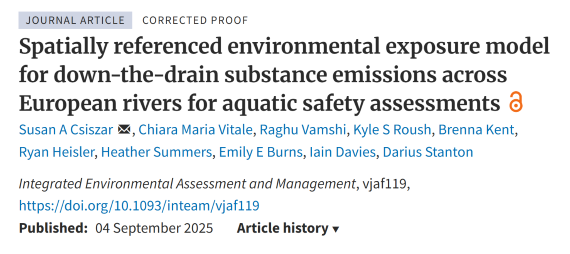
The research, titled “Spatially referenced environmental exposure model for down-the-drain substance emissions across European rivers for aquatic safety assessments,” is now available in Integrated Environmental Assessment and Management.
Using European data on wastewater treatment plant infrastructure and location, along with global spatial datasets on population, river flows, and routing, the model estimates environmental concentrations of chemicals disposed of via household drains. It accounts for key environmental processes such as river connectivity, in-stream chemical routing, and degradation.
Four consumer-use chemicals with down-the-drain disposal routes were used as case studies:
- Linear alkylbenzene sulfonate and alkyl sulfate – common surfactants found in laundry detergents
- Oxybenzone and octinoxate – UV filters used in personal care products
Monitoring data representing spatial variability across Europe were used to compare against the model’s outputs. The results showed that the model delivers predictive yet conservative estimates, with 90th percentile modeled concentrations aligning with monitored values within a factor of 2–8 across all case studies.
“This model represents an important advancement in exposure assessment tools for environmental safety evaluations,” said Darius Stanton, ACI Director, Regulatory Science, and a co-author of the research. “It enables more consistent, science-based decision-making and supports global efforts to evaluate chemical exposure responsibly.”
The model can be used in prospective chemical safety assessments, comparing predicted environmental concentration levels with established predicted no-effect concentration (PNECs) levels. It also demonstrates compatibility with tiered risk assessment approaches by producing results in line with real-world monitoring data.
The co-authors of this paper include Susan A. Csiszar, Chiara M. Vitale, and Kyle S. Roush (Procter & Gamble); Raghu Vamshi and Brenna Kent (Waterborne Environmental); Ryan Heisler (International Collaboration on Cosmetics Safety); Heather Summers (Integral Consulting); Emily E. Burns and Iain Davies (Personal Care Products Council); Darius Stanton (American Cleaning Institute).
The American Cleaning Institute® (ACI – www.cleaninginstitute.org) is the Home of the U.S. Cleaning Products Industry® and represents the $60 billion U.S. cleaning product supply chain. ACI members include the manufacturers and formulators of soaps, detergents, and general cleaning products used in household, commercial, industrial and institutional settings; companies that supply ingredients and finished packaging for these products; and chemical distributors. ACI serves the growth and innovation of the U.S. cleaning products industry by advancing the health and quality of life of people and protecting our planet. ACI achieves this through a continuous commitment to sound science and being a credible voice for the cleaning products industry.